Suppressors: Let's Take a LOOK!
Watson Coleman Reintroduces HEAR Act to Ban Suppressors — Just as the Suppressor Market Booms After NFA Tax Elimination

The timing tells you everything you need to know about how seriously anti-gun Democrats are taking the post-OBBB firearms market reality.
Last July, President Donald Trump signed the One Big Beautiful Bill, eliminating the $200 federal transfer tax on suppressors, short-barreled rifles, short-barreled shotguns, and “any other weapons” designated under the National Firearms Act. The tax elimination took effect January 1, 2026. Suppressor sales jumped immediately and have remained at elevated levels through the spring, turning suppressors into one of the fastest-growing segments of the firearms industry.
The response from anti-gun House Democrats: introduce legislation to ban suppressors entirely.
Watson Coleman’s bill
On June 8, Rep. Bonnie Watson Coleman (D-N.J.) reintroduced the Help Empower Americans to Respond (HEAR) Act, federal legislation that would ban the importation, sale, manufacturing, transfer, and possession of firearm suppressors in the United States.
The HEAR Act was first introduced in 2019 in the aftermath of the Virginia Beach mass shooting. Watson Coleman has reintroduced it in each subsequent Congress — 2021, 2023, and now 2026 — without ever advancing it to a floor vote. The 2026 version appears to be a House-only effort; no Senate companion has been introduced.
Watson Coleman announced earlier this year that she is not seeking reelection in 2026. Her HEAR Act reintroduction is essentially a closing-act political statement rather than a serious legislative vehicle — but it’s a useful preview of what congressional Democrats will pursue if they win back majorities in November.
The bill’s actual provisions
The HEAR Act would do more than just stop new suppressor sales. The legislation would:
Ban the importation, manufacturing, sale, transfer, and possession of all firearm suppressors and “firearm mufflers”
Provide a 90-day grace period after enactment for current owners to comply
Establish a federal buyback program funded through Byrne JAG grants for owners to surrender their suppressors
Provide limited exceptions for current and former law enforcement personnel, Atomic Energy personnel for specific purposes, and authorized testing or experimentation
In plain terms: under the HEAR Act, every lawful suppressor owner in America — an estimated six million-plus suppressors in civilian circulation as of June 2026 — would have 90 days to surrender their property to the federal government or become a federal criminal. The buyback would presumably offer some compensation, but the underlying mechanism is confiscation through legal coercion.
That’s a meaningful escalation from the typical gun-control approach of restricting future sales. The HEAR Act targets existing lawful property held by Americans who legally acquired their suppressors through the federal NFA process.
Watson Coleman’s “tools of murder” claim doesn’t survive scrutiny
Watson Coleman’s case for banning suppressors leans on rhetoric that doesn’t survive contact with actual data:
“Silencers are not tools of self-defense, they are tools of murder. They have no legal application which is why law enforcement officials around the country have been calling for their elimination. The HEAR Act will save lives and is part of the common sense approach to firearms legislation that polls show has widespread support among voters on both sides of the aisle.”
A few problems with that framing.
First, suppressors are extraordinarily rarely used in crimes. Federal data and academic research have consistently shown that suppressors appear in criminal incidents at rates orders of magnitude below their prevalence in lawful civilian ownership. With six million+ suppressors in civilian circulation and federal trace data showing suppressors as a vanishingly rare component of firearm-related crime, calling them “tools of murder” is rhetoric, not analysis.
Second, the “no legal application” claim is demonstrably false. Suppressors are widely used by hunters (hearing protection during hunts), competitive shooters (reduced muzzle blast and concussion in indoor and outdoor ranges), recreational shooters (basic hearing protection during range sessions), and home defense practitioners (avoiding hearing damage in confined defensive shooting scenarios). Watson Coleman’s own state of New Jersey is one of only eight states that ban civilian suppressor ownership; the other 42 states allow lawful civilian use precisely because the “legal applications” are real and well-documented.
Third, the “law enforcement officials around the country have been calling for their elimination” framing is wildly inaccurate. Law enforcement officers across the country regularly use suppressors themselves for the same reasons civilians do — hearing protection and noise reduction. Major law enforcement professional organizations have not endorsed suppressor bans. Watson Coleman either doesn’t know what law enforcement actually thinks about suppressors or is misrepresenting it.
What suppressors actually do
The fundamental problem with the “tools of murder” framing is that it bears no resemblance to what suppressors actually do.
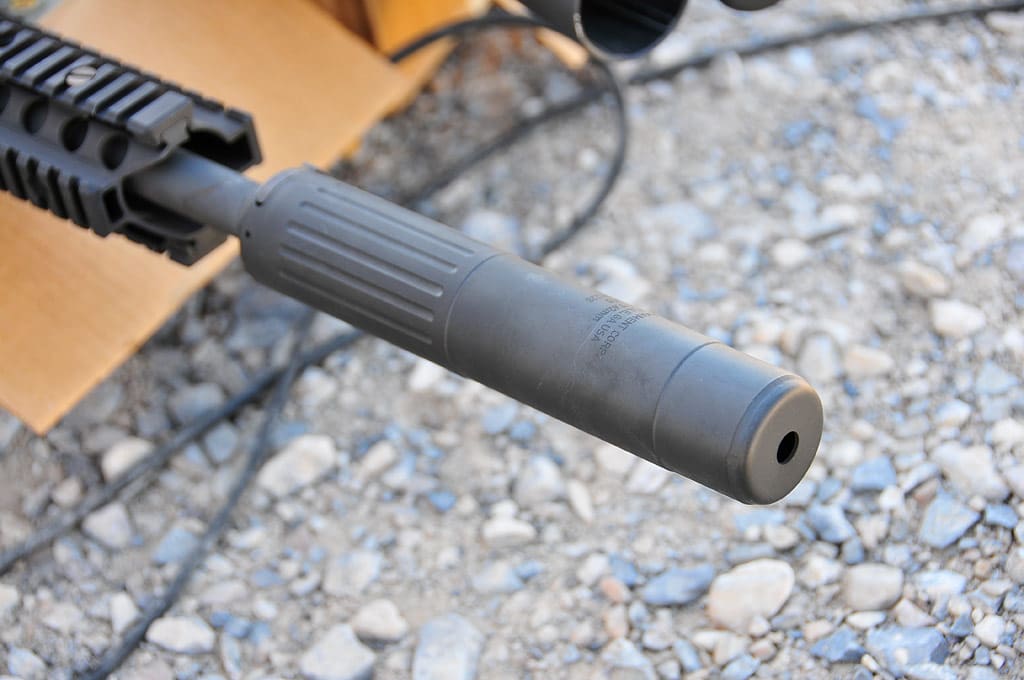
A suppressor doesn’t make a firearm silent. It reduces the muzzle blast from approximately 160-165 decibels (loud enough to cause permanent hearing damage with a single unprotected exposure) to approximately 130-140 decibels (still louder than a jackhammer). Suppressed firearms are clearly identifiable as firearms by sound. The Hollywood “silent kill” depiction Watson Coleman appears to be reacting to is fiction.
What suppressors actually accomplish:
Protect shooters and bystanders from hearing damage during lawful firearms use
Reduce noise impact on neighbors near rural shooting ranges
Allow hunting without permanent hearing damage from unprotected firearm reports
Enable family members and instructors to participate in firearms training without ear protection complications
Reduce muzzle blast in defensive shooting scenarios where ear protection isn’t available
None of these applications resemble “tools of murder.” All of them resemble what the rest of the developed world recognizes as basic hearing protection — suppressor sales without permits or transfer taxes are standard practice in European countries that otherwise have much more restrictive gun laws than the United States. Finland, France, Norway, and the United Kingdom either allow suppressor ownership without significant restrictions or actively encourage it for hearing protection during hunting.
The Newtown Action Alliance
The HEAR Act is backed by the Newtown Action Alliance, with chairwoman Po Murray providing the standard advocacy framing:
“When gunfire erupts, every second matters. Survivors know we should never make it harder to recognize danger or respond to violence. Silencers can delay recognition of gunfire and slow emergency response when lives are at stake.”
The “delay recognition of gunfire” framing assumes the Hollywood suppressor narrative — that suppressed firearms are silent and undetectable. They aren’t. Suppressed gunfire at 130-140 decibels remains clearly identifiable as gunfire. The Virginia Beach shooter who used a suppressor in 2019 — the incident that prompted the original HEAR Act introduction — killed 12 people in a building where everyone present knew gunfire was happening despite the suppressor’s use. The suppressor didn’t enable the killings; it just attended them.
Murray’s framing also ignores that suppressors are heavily regulated under existing federal law. Every suppressor transaction in the United States requires a federal background check, ATF registration, fingerprinting, photographs, and (until January 2026) a $200 transfer tax. The federal regulatory framework around suppressors is among the most extensive applied to any firearm-related device. The Newtown Action Alliance position essentially is that no level of regulation short of complete prohibition is acceptable for suppressors — regardless of the device’s actual role in crime or its legitimate civilian applications.
The timing of this matters politically
What makes the HEAR Act’s June 2026 reintroduction particularly notable is the political context. The OBBB’s elimination of the suppressor transfer tax took effect January 1, 2026. Five months later, the suppressor market is booming, civilian ownership is expanding, and the legislative trajectory at the federal level is toward continued deregulation rather than restriction.
Rep. Lauren Boebert’s Freedom From Taxes Act would extend the OBBB approach to the remaining NFA-taxed items (machine guns and destructive devices). The SAF and FPC Brown v. ATF litigation seeks to invalidate the rest of the NFA regulatory framework now that the underlying tax basis has been eliminated. The Cekada ATF reform package includes streamlining of remaining NFA processes.
Watson Coleman’s HEAR Act is the legislative pushback against that entire trajectory. With Democrats in the House minority and a Republican Senate, the bill has essentially no path to passage in the current Congress. But it serves as a marker for what congressional Democrats will pursue if voters give them majorities in 2026 or 2028.
What this means going forward
The HEAR Act’s reintroduction isn’t a serious threat to lawful suppressor ownership in the current Congress. The political math doesn’t work — Republicans hold majorities in both chambers, the Trump administration would veto any suppressor ban that somehow reached his desk, and the broader political momentum on suppressor policy is toward continued deregulation.
But the HEAR Act matters as a signal of what congressional Democrats actually want. The bill targets six million-plus suppressors currently owned by lawful Americans for confiscation through a buyback program. It treats every current suppressor owner as a future criminal if they do not comply with a 90-day surrender deadline. It bans the manufacturing, sale, and transfer of an entire category of legally owned firearm accessories.
For lawful suppressor owners — and the Silencer Shop and other industry participants serving the growing market — the HEAR Act is a reminder of what the gun-control wing of American politics actually wants to do if they get the votes. The midterm elections will determine whether they get the votes.
Until then, suppressor sales will continue, the market will continue to expand, and Watson Coleman’s bill will sit in committee, like its predecessors in 2019, 2021, and 2023. Whether it stays there indefinitely depends on the choices American voters make in November.